
2 The challenges and costs of financing agrifood systems transformation
The cost of transforming agrifood systems to achieve better health, improved livelihoods and environmental sustainability is substantial—multiple orders of magnitude beyond current spending. At the same time, the hidden health, environmental and social costs (market externalities) of how food is produced, processed and consumed equals almost the entire monetary value of the global agrifood sector.
Almost one-third of the world’s population (31.9 per cent) cannot afford a healthy diet10 and food insecurity continues to rise. At the same time, 3.83 billion people – many of whom are among the poorest in the world – depend on agrifood systems for their livelihoods.11 These interconnected pressures highlight both the fragility of current agrifood systems and the scale of the externalities they create.
Despite these challenges, there are also substantial economic opportunities in producing and distributing healthy and environmentally sustainable food for a growing population that is increasingly wealthy. In terms of societal social and economic benefits, as well as long-term returns on investment, there is a clear investment case for transforming agrifood systems. Although the required investments may appear high in comparison to current levels of ODA, the amount is relatively modest when viewed against global economic wealth and GDP.
Transforming agrifood systems is critical for addressing major global challenges, including food security, nutrition, livelihoods, equity and environmental sustainability. Food production, processing, distribution and consumption are deeply interconnected, and pressures such as climate change, conflict, rising costs, and limited access to healthy diets continue to expose systemic weaknesses in many countries. The SOFI 2026 report highlights the fact that in absolute terms, there are still large numbers of people – some 2.1 billion – facing moderate or severe food insecurity.12 In addition, many people facing moderate food insecurity and lacking access to healthy diets could benefit from agrifood system transformation, not just targeted interventions addressing food security and basic nutrition.
Within this broader landscape, Sustainable Development Goal 2 (SDG2) on “Zero Hunger” remains relevant for its objectives related to reducing hunger, improving nutrition, boosting agricultural productivity and strengthening resilience. However, the hunger and nutrition components captured under SDG2 represent only a subset of the much wider transformation needed. Achieving healthy, sustainable, and inclusive agrifood systems requires coordinated action that extends well beyond these targets, and is important for countries at all income levels, including middle‑income countries (MICs). Opportunities for private sector engagement are substantial, although they are more constrained in fragile and conflict‑affected contexts.
2.1 The hidden costs of agrifood systems
Today’s agrifood systems are fundamental to food security, livelihoods and economic development. While advances in agricultural productivity, transport, storage and preservation have vastly expanded food production and availability, the way these systems currently operate also generates large, unpriced health, environmental and social impacts, stemming from the economic consequences of diet‑related diseases, productivity losses, pollution, greenhouse gas and nitrogen emissions, land use change, and water depletion. In the SOFA 2023 report, the United Nations estimated that the hidden annual costs of agrifood systems amount to at least US$12.7 trillion,13 equivalent to nearly 10 per cent of global GDP and more than the global GDP of the agrifood sector (estimated at US$10 trillion, or 12 per cent of global GDP).14 More than 70 per cent of these hidden costs originate from unhealthy dietary patterns, particularly in high‑income countries (HICs) and upper‑middle‑income countries (UMICs), while around 20 per cent are linked to environmental degradation.15 In low‑income countries (LICs), poverty and undernourishment constitute the most significant share of these impacts. The distribution of these costs varies across income groups: the United Nations’ analysis shows that LICs face hidden costs exceeding a quarter of their GDP, compared with less than 12 per cent in MICs and under 8 per cent in HICs.16
According to the Food and Land Use Coalition, investing in transforming food and land use systems could unlock over US$4.5 trillion in new business opportunities annually.17
These figures capture the extent to which current agrifood systems generate further spending on healthcare, lost productivity and environmental remediation. They also highlight how existing agrifood systems place mounting pressure on national budgets, particularly in countries where fiscal space is already constrained.
When substantial public resources are spent on such secondary impacts, less finance remains for investments in other areas, including making agrifood systems more sustainable and resilient. Over time, reducing these underlying burdens could ease pressure on national budgets. Conversely, not doing so will exacerbate financial pressures.
These hidden costs are also likely to increase as climate-related disasters become more frequent and severe. Without greater investment in resilient agrifood systems, governments are likely to face rising expenditure on disaster response, humanitarian assistance, infrastructure recovery and social protection, further reducing fiscal space for long-term development investments.
2.2 The estimated costs of financing agrifood systems transformation and the financing shortfall
While agrifood systems are central to addressing climate change, tackling poverty and protecting biodiversity, ODA grants to the agriculture, forestry and fisheries sectors have remained flat since 2017, at 5-6 per cent of total ODA,18 amounting to only US$14.1 billion globally in 2022. By comparison, the annual National Health Service budget in the United Kingdom was approximately US$227 billion in 2022.19 Climate finance amounted to approximately US$1 trillion in 2022, yet less than 4 per cent of this financing is directed towards agriculture,20 and less than 1 per cent supports small-scale agriculture.21 Furthermore, ODA to the sector is just a fraction of global spending on agricultural subsidies – even the most generous estimates of ODA to agriculture is only 10 per cent of global subsidies, which most often do not directly support activities aligned to sustainable development.
To address these issues, it is critical for governments, donors, development partners and the private sector to be clear about the scope of the challenge. Financing to address only hunger and nutrition specifically looks very different to financing for agrifood systems transformation. One key point from the SOFI 2024 report is that shifting from a narrow focus on food security and nutrition to a broader agenda of agrifood systems transformation dramatically increases the financing required, from billions of dollars to trillions.
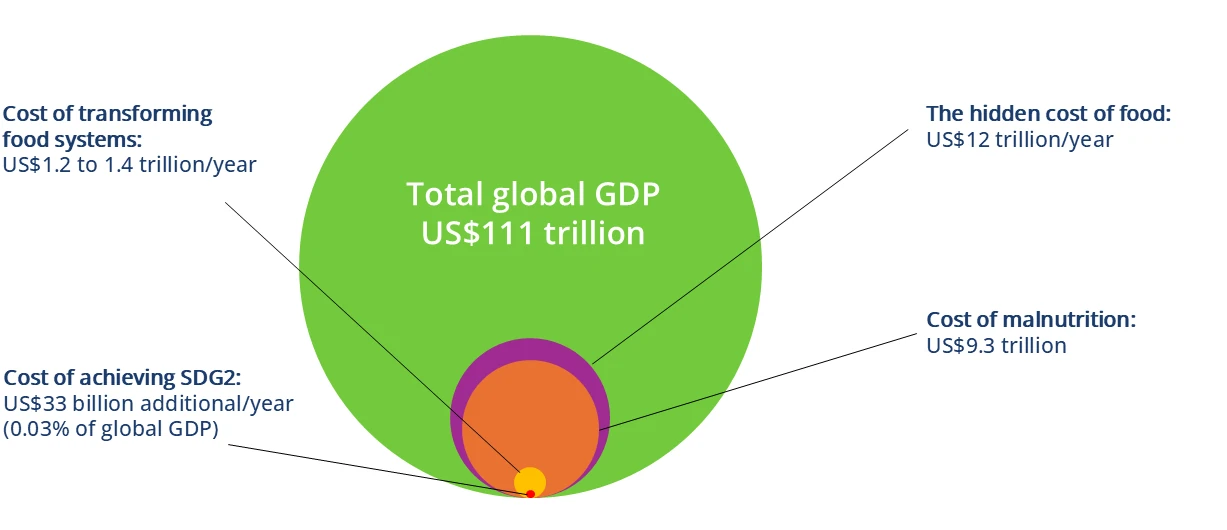
Note: This figure illustrates the approximate investments needed to transform food systems relative to the hidden costs of not taking action and was originally developed for the GDPRD’s 2025 White Paper “Financing Agrifood Systems for People, Planet and Prosperity”. Based on 2024 data.
Figure 1 highlights the relative scale of costs associated with agrifood systems compared to total global GDP, estimated at about US$111 trillion.22 The Ceres2030 Report estimates that ending hunger by 2030 would require around US$33 billion each year (with US$14 billion in ODA and US$19 billion from LICs and MICs),23 while the cost of fully transforming agrifood systems is larger, at approximately US$1.2–1.4 trillion annually.24
Despite these differences, both the cost of ending hunger and the cost of transforming agrifood systems remain small in comparison to the massive hidden costs generated by current agrifood systems. The hidden cost of food amounts to roughly US$12.7 trillion per year, which includes about US$9.3 trillion in hidden costs of health, US$2.9 trillion in environmental costs, and US$0.5 trillion in social costs.25 This figure thus illustrates that the economic burden of inaction far exceeds even the highest estimates of transformation costs. This stark contrast emphasizes that while investments in food system improvements may differ in magnitude, and that estimated costs vary, they are ultimately modest relative to the scale of the hidden costs they could help reduce, making a strong case for decisive and sustained action. Box 2 provides a complementary breakdown from an earlier analysis, illustrating how these hidden costs arise across health, environmental and social dimensions.
How donors, governments, the private sector and development partners approach the financing challenge thus significantly impacts the solutions for addressing such gaps. Public and private sector financing for hunger and malnutrition only is more concrete and targeted, as it tends to focus on specific outcomes that are measurable in the short- to medium-term, making it easier to determine countries’ progress and estimate the scale of financing required to close the gaps. On the other hand, transforming agrifood systems requires structural, normative and systemic changes in food production, distribution and consumption. Achieving this requires multistakeholder engagement and more diversified financing approaches, such as climate and blended finance, as well as public-private partnerships. Each approach requires tailored solutions and will entail different levels and modalities of funding.
Box 2: The hidden cost of food “Over half of the hidden costs (US$6.6 trillion) arise from the impacts of obesity, undernutrition and pollution. An additional US$3.3 trillion arise from the negative impacts of current food and land-use systems on the climate and natural capital …. The remaining US$2.1 trillion of hidden costs comprise the economic costs of food loss and waste, fertilizer leakage, and the negative impacts on rural welfare from unequal income distribution and people’s inclusion within the value chain.” FAO, United Nations Development Programme (UNDP) and the United Nations Environment Programme (UNEP). 2021. A Multi-Billion-Dollar Opportunity – Repurposing Agricultural Support to Transform Food Systems.
At a macro level, a key challenge for financing is not only defining the issues, but ensuring that these are consistently understood by everyone involved in making investments, including governments, donors, private sector and international financial institutions (IFIs). In this context, it is essential to acknowledge that ending hunger and overcoming food insecurity is just part of the wider challenge of transforming agrifood systems.
2.3 Challenges
So why aren’t development and investment goals being met? Transforming agrifood systems, and mobilising investments to do so, presents several challenges, including:
- Risk: weather, natural disasters, commodity price fluctuations, currency fluctuations and policy uncertainty all make investing in the agrifood sector inherently risky.
- High costs associated with serving smallholders and small and medium-sized enterprises (SMEs): In LICs and MICs, the agrifood sector is predominantly made up of SMEs, whose owners often have limited financial understanding. The small loans sizes needed, along with the necessity for intermediary financing and technical support institutions, generates high costs to serve these groups.
- Informality and lack of collateral: Much of the agrifood sector still operates with informal market structures, and many farmers and enterprises have limited or no collateral for securing loans.
- Impeding domestic policy environment: Inadequate, excessive or poorly enforced regulations combined with corruption add additional complications and disincentives for investors.
- Macroeconomic conditions: Monetary policy, export regulations, exchange rate volatility, credit ratings, inflation dynamics, weak property rights, poor infrastructure and geopolitical tensions are all factors that make it difficult for countries to attract investments into the agrifood sector.
- Political economy factors: Ensuring populations have enough affordable food is a highly political issue. Furthermore, addressing the needs of large numbers of rural producers and urban consumers, both of whom experience high rates of poverty in many parts of the world, means that agricultural policy is highly influenced by political pressures. This can swing policy and government investment towards short-term political goals and away from focusing on long-term sustainability and sound economic strategies.
- Distorting agricultural support mechanisms: Historically, support to the agrifood sector has prioritized the production of high calorie staples, often at the expense of the environment or more nutrient dense production. This, along with creating other market inefficiencies, adds further disincentives for transforming agrifood systems.
2.4 Repurposing Agricultural Support
Governments worldwide provide enormous sums to the agricultural sector, reaching US$851 billion annually in 2020–2022 across the 54 countries covered by OECD analysis.26 The majority of this support is directed toward producers rather than general services or consumer support, and is often poorly targeted, disproportionately benefiting larger and wealthier farmers, particularly where support is linked to production volumes or area under cultivation.27 As a result, existing support systems frequently reinforce inequalities within the agricultural sector while failing to align with broader development, environmental and nutrition goals. Evidence from joint FAO, UNEP and UNDP analysis (see also box 2) shows that repurposing even a portion of agricultural support and subsidies towards sustainable, climate-smart solutions and research and development could go a long way towards increasing productivity, reducing environmental impacts and improving livelihoods.28
However, redirecting and repurposing agricultural subsidies is far from straightforward. In many agrarian economies, farmers represent politically influential constituencies, creating strong disincentives for governments to disrupt established support systems. Consequently, political considerations often constrain reform efforts, even where existing policies are inefficient or misaligned with broader development objectives.
The current structure of agricultural support generates significant negative outcomes across multiple dimensions. In particular, production-linked payments encourage the expansion of emission-intensive activities and the intensive use of inputs, amplifying environmental pressures while concentrating benefits among those already best positioned to scale production.29 At the same time, the focus of market price support and budgetary payments on a narrow range of staples and protein-rich foods may have disproportionately encouraged production of calorie-dense foods relative to pulses, seeds, fruits, vegetables and other nutritious foods, with prices for fruits and vegetables rising relative to processed foods derived from cheap staples since the 1990s.30 Repurposing this support could simultaneously reduce greenhouse gas emissions, improve equity and make healthy diets more accessible.31
A range of options exist for redirecting existing agricultural expenditure, though trade-offs between socioeconomic, environmental and health goals are inevitable.32/33 Some of the most substantial rewards could come from redirecting public support towards research and development in technologies that could simultaneously strengthen resilience and boost productivity while reducing emissions, supporting rural infrastructure, and paying farmers to supply public goods such as ecosystem services or carbon sequestration.34 Importantly, even reallocating budget transfers in a way that reduces costs for farmers and boosts productivity over the longer term can reduce farming household incomes in the short term, meaning transitional assistance and extended social safety nets may be needed to bridge this period, particularly for poorer farming households.35
Despite the theoretical potential of repurposing, there are substantial political economy barriers to reform, as illustrated by recent farmer protests in Europe and India.36/37 Opposition can come from interest groups benefitting from the status quo, and momentum for reform can be stalled through lack of information, concerns about government capacity, and governance structures that impede deeper reform.38 For LICs and LMICs, where public funds to support agriculture are severely constrained, there is even more pressure to use those funds in a way that maximises inclusivity and sustainability while minimising trade-offs,39 and tools such as FAO’s Monitoring and Analysing Food and Agricultural Policies (MAFAP) framework can help optimise budget allocations accordingly.40 Ultimately, repurposing alone will not be sufficient, and complementary policies – such as carbon pricing, food taxation and expanded development finance flows to LICs – will also be required alongside inclusive reform processes that incorporate distributional, participative and recognitional justice.41
2.5 Addressing private sector investment challenges
Private sector financing in agrifood systems is critical to supplement limited public resources. However, at the country level, private sector investment in agrifood systems and agriculture remains challenging, especially for local investors and banks, due to the perceived risks associated with volatile markets, climate impacts and regulatory uncertainties. In addition, the limited availability of investable business models and large-scale bankable projects, alongside the perceived risks associated with early-stage business models that have long lead times and high levels of technical assistance (in particular those focused on smallholder farmers in developing countries) significantly dampens investor interest.42
“Not all countries have access to the same amount of finance, and unfortunately the most vulnerable countries, the ones that have also been hurt by recent shocks like the climate and economic crisis, are also those that appear to be the riskiest. Financial actors do not like to invest in risky places. We really need to change the incentives.” Report interviewee
The public sector has a role to play in creating a more supportive environment for private sector investment, particularly in more fragile and conflict affected contexts. De-risking mechanisms, clear and consistent policy frameworks, and long-term government commitment to agricultural development strategies are essential to build investor confidence. Policy predictability is especially important, as it allows private actors to make longer-term investment decisions with greater certainty.43 Strengthening data systems and improving risk assessment tools can further support investment by reducing information asymmetries and enhancing transparency, helping to build investor confidence and attract more private sector financing.44
Ultimately, unlocking private sector financing will be key to addressing the broader agrifood financing gap. However, this will require coordinated efforts to align public policies with private investment incentives, alongside targeted interventions to mitigate risk and expand the pipeline of viable investment opportunities.
2.6 The critical role of ODA, the challenge of donor coordination and the need for better data and monitoring
Official development assistance is a critical piece of the food financing puzzle. Globally, ODA grants and loans remain one of the major sources of development finance for agriculture and food security. It is estimated that the global volume of ODA grants for agriculture and food security increased significantly from US$8.9 billion per year in 2007 to US$14 billion in 2021,45 while total ODA and other official flows (OOF) for core investments in food security and nutrition totaled US$50 billion.46 Investing in agrifood systems requires a long-term vision and approach that acknowledges that investments today will bear fruit over time. However, amid multiple crises, economic uncertainty, rising inflation, mounting debt and increasing demands for short-term humanitarian assistance, governments appear less willing and more risk averse to making long-term investments that could strengthen resilience to crises and shocks in a more sustainable manner. With less donor funding available, especially where it is most needed and in sectors where it can be the most transformative, donors need to be more willing to take risks and work towards mobilizing their resources more catalytically, so that they can attract domestic and private sector resources.
At the country level, the misalignment of country and donor financing mechanisms often makes delivering assistance on the ground challenging. The frequent incompatibility between the financing, budgeting and reporting cycles of different donors complicates coordination and increases transaction costs for partner governments. The lack of good data on available sources of financing – domestic public finance, international development finance and private sector finance – also challenges coordination. Effective monitoring and evaluation of new and innovative modalities of financing can help identify conditions for success, as well as failure, and provide opportunities for understanding which approaches work best and under what conditions.
These challenges are reflected across the recent literature on agrifood systems financing. Boxes 3–6 summarize the key findings of selected reports that inform the analysis in this paper, including evidence on financing gaps and allocation, coordination and transparency, the catalytic role of ODA, and opportunities to mobilize private capital.
Box 3: Key messages from the State of Food Security and Nutrition in the World 2024 report
-
The world is off track to achieve SDG2: 2.33 billion people are moderately or severely food insecure and 30 per cent of the world’s population is unable to afford a healthy diet.
-
There is currently no clear picture of the level of financing for food security and nutrition – neither that available nor that additionally needed.
-
Food security and nutrition receive < 25 per cent of ODA and OOF – approximately US$76 billion per year (2017-2021) – of which only 34 per cent addresses drivers of food insecurity.
-
The financing gap to drive food system transformation is up to several trillion US dollars per year; however, the cost of eliminating hunger is significantly lower than cost of ensuring everyone can afford a healthy diet.
-
Low-income countries are much less able to access financing flows for tackling food insecurity and malnutrition despite high prevalence in these countries.
-
For countries with limited ability to access financing flows, grants and concessional loans are the most suitable financing options.
-
Countries with moderate ability to access financing can increase domestic tax revenues, linking taxation to food security and nutrition outcomes and utilise instruments such as green, social, sustainable and sustainability-linked bonds.
-
The current food security and nutrition financing architecture is highly fragmented and needs a shift from a siloed approach to a more holistic perspective.
-
Transparency and harmonizing data collection are crucial for improving coordination and targeting financing effectively.
-
Donors and other international actors need to increase their risk tolerance and be more involved in de-risking activities.
-
Governments can invest in public goods, increase food security and nutrition expenditure and consider repurposing policy support.
Box 4: Key messages of the GDPRD White Paper “Financing Agrifood Systems for People, Planet and Prosperity”
Transforming agrifood systems is one of the smartest investments the world can make for prosperity, security, sustainability and resilience. Agrifood systems must become central to the global financing agenda.
-
The investment opportunity in agrifood systems is immense and the cost for transformation is affordable. About US$1.2 to US$1.4 trillion annually is estimated for transforming agrifood systems, which is a fraction compared to the current system’s invisible cost of around US$12 trillion per year.
-
Responsible private investment in agrifood systems can unlock as much as US$4.5 trillion annually in new business opportunities.
-
Improving agrifood systems offers substantial economic and social benefits for governments, businesses, and communities. Conversely, a failure to invest will result in far-reaching costs, with the poorest suffering the most.
-
ODA and OOF for agrifood systems remain highly insufficient and the mobilization of private capital is increasingly essential. However, the core challenge lies not in the funding availability, but rather in prioritization and strategic allocation.
-
Transforming agrifood systems must be designed to reach and benefit those who are most critical to the system’s resilience and sustainability: small-scale producers and enterprises, women, youth and Indigenous Peoples.
-
Overall, investing in agrifood systems represents the most strategic lever for sustainable development. Impactfully transforming climate, health, biodiversity, and peace, while serving as the primary engine for inclusive economic growth and global stability.
Box 5: Key messages of the joint GDPRD and Shamba Centre report “Unleashing the Catalytic Power of Donor Financing to Achieve Sustainable Development Goal 2”
If donors and DFIs take higher risks with their grants and lending, every donor dollar has the potential to mobilize four dollars in commercial finance, unlocking more finance and domestic lending for SMEs.
-
Blended finance is the use of concessional finance from donors and philanthropic foundations to mobilize commercial finance from DFIs and private investors to invest in projects that are too risky and lack sufficient returns for private investors.
-
Blending public and private sources of finance is nascent and taking it to scale requires widespread changes by donors, development finance institutions (DFIs) and their beneficiaries.
-
Blended finance can make the biggest contribution to SDG2 by focusing on the financing missing middle for SMEs of US$50,000 to US$2 million.
-
Additional public investment to achieve SDG2 is estimated at US$33-50 billion per year. The required donors’ share is about US$28 billion – double current levels of spending.
-
ODA for agriculture and food security has been static at US$12-15 billion per year since 2010.
-
Only around 2-3 per cent of ODA (all sectors) is directed towards blended finance and the entire blended finance market (all sectors) has a median annual financing of approximately US$14 billion, with about half (US$7.69 billion) dedicated to climate-focused deals. The proportion of transactions (not value) targeted to agriculture was about 41 per cent in 2022.
-
DFIs are governed by rules that discourage them from taking risks to provide finance that would otherwise not be available from commercial lenders.
Box 6: Key messages from other relevant reports on financing for food systems, agriculture and rural development
Financing for Sustainable Development Report 2026: Implementing the Sevilla Commitment United Nations Inter-Agency Task Force on Financing for Development
-
Stresses the enlarging finance gaps to support the achievement of the SDGs, aligned with global impacts pressuring multilateralism under risk.
-
Demonstrates the financial instability in least developed countries exacerbated by low tax revenue, fall in ODA and squeeze in international investments.
-
Highlights the importance of Sevilla Platform for Action (SPA), which supports voluntary collaboration between governments, public resources and private businesses, to re-boost multilateralism in a fragmented world.
Financing for Regenerative Agriculture 2024. The Rockefeller Foundation
-
A massive “bankability gap” exists — annual transition financing need is US$200-450 billion, but current funding flows are only about a tenth of that.
-
The shortfall stems not from lack of capital but from pricing failures, entrenched government policies, and a data deficit that undermine financier confidence.
-
Concessional capital is critical now, catalysing early deals and crowding in commercial investment via instruments like operating loans, blended finance and outcomes-based funds.
Global Landscape of Climate Finance 2025. Climate Policy Initiative
-
Provides a comprehensive overview of global climate flows, highlighting innovation from public development banks, emerging markets and developing economies and private investments, and identifies gaps.
-
Emphasises that while climate investment is increasing, it is insufficient to avoid the worst impacts of climate change.
-
Notes that agriculture and forestry finance has the potential to create a catalytic effect, driven by continued growth, technological advancements, and policy support.
-
Underscores the importance of country-tailored investment roadmaps and transparent invest tracking process to accomplish national climate goals and achieve a net-zero balance.
State of Food Security and Nutrition in the World 2025 report
-
Delivers an in-depth analysis of the current state of food security and nutrition, highlighting a slow recovery that remains inadequate to offset, and explaining the cause of soaring food prices related to recent global events.
-
Underscores the importance of countering food inflation through fiscal policies focusing on macroeconomic stability and the implementation of effective social protection systems.
-
Emphasizes investing in data as Market Information Systems (MIS) to counter market instability on the verge of global crises. Such efforts contribute to long-term resilience, requiring continuous investment and financing to establish a sustainable agrifood system.
Financing Food for a Better Future. FAO 2025
-
Serves as a milestone through an overview of financing in agrifood systems, outlining an engaged approach to navigating overlapping crises and the growing demand for sustainability.
-
Illustrates necessity on increasing finance, marking its insufficiency in current terms to end hunger, improve sustainability and resilience, as well as generating economic growth and decreasing inequality.
-
Emphasizes that financing on agricultural production and strengthening social safety nets is catalytical, however it is also crucial to consider institutional capacity of countries, which might mitigate efforts at a large-scale finance direction.
-
Highlights the role of innovative financial instruments as key drivers for leveraging long-term, ambitious investments aimed at rural and remote populations.
Notes
-
IFAD, UNICEF, WFP and WHO. 2025. The State of Food Security and Nutrition in the World 2025 – Addressing high food price inflation for food security and nutrition. Rome. https://doi.org/10.4060/cd6008en. ↩
-
Davis, B., Mane, E., Gurbuzer, L.Y., Caivano, G., Piedrahita, N., Schneider, K., Azhar, N., Benali, M., Chaudhary, N., Rivera, R., Ambikapathi, R. and Winters, P. 2023. Estimating global and country-level employment in agrifood systems. FAO Statistics Working Paper Series, No. 23-34. Rome, FAO. https://doi.org/10.4060/cc4337en. ↩
-
SOFI 2026. https://doi.org/10.4060/cd8306en ↩
-
FAO. 2023. The State of Food and Agriculture 2023. Revealing the true cost of food to transform agrifood systems. Rome. https://doi.org/10.4060/cc7724en. ↩
-
SOFI 2024. https://doi.org/10.4060/cd1254en. ↩
-
SOFI 2023. https://doi.org/10.4060/cc7724en. ↩
-
Ibid. ↩
-
Food and Land Use Coalition. 2019. Growing Better: Ten Critical Transitions to Transform Food and Land Use. ↩
-
OECD Data Explorer • Aid (ODA) by sector and donor [DAC5]. ↩
-
Public Expenditure Statistical Analyses 2018 (publishing.service.gov.uk). ↩
-
Climate Policy Initiative. 2023. Global Landscape of Climate Finance. ↩
-
Climate Policy Initiative. 2023. 44% drop in climate finance to small-scale agrifood systems reveals need for action. Press Release. 22 November 2023. ↩
-
See: https://data.worldbank.org/indicator/NY.GDP.MKTP.CD?most_recent_value_desc=true&year_high_desc=true. ↩
-
Laborde, D., Parent, M. and Smaller, C. 2020. Ending Hunger, Increasing Incomes, and Protecting the Climate: What Would It Cost Donors? Ceres2030. International Institute for Sustainable Development and International Food Policy Research Institute. ↩
-
The estimated costs of transforming agrifood systems vary substantially depending on which factors are being included and the timeframe over which the investments are being made: see SOFI 2024, chapter 4.1.; and Von Braun, J., Chichaibelu, B.B., Laborde, D., and Torero, M. 2024. “Cost of Ending Hunger – Consequences of Complacency, and Financial Needs for SDG2 Achievement. In these two papers, US$1.2-1.4 trillion per year till 2030 is taken as an indicative level of investment that would enable substantial progress towards overcoming malnutrition in all its forms while tackling the structural constraints to more sustainable and equitable agrifood systems. It is important to note that the costs are a global total and not just for low- and middle-income countries. ↩
-
SOFI 2023. https://doi.org/10.4060/cc7724en ↩
-
OECD. 2023. Agricultural policy monitoring and evaluation 2023: adapting agriculture to climate change. Paris, OECD Publishing. https://doi.org/10.1787/b14de474-en. ↩
-
Damania, R., Balseca, E., de Fontaubert, C., Gill, J., Kim, K., Rentschler, J., Russ, J. and Zaveri, E. 2023. Detox development: repurposing environmentally harmful subsidies. Washington, DC, World Bank. ↩
-
FAO, UNDP and UNEP. 2021. A multi-billion-dollar opportunity – Repurposing agricultural support to transform food systems. Rome, FAO. https://doi.org/10.4060/cb6562en. ↩
-
Laborde, D., Mamun, A., Martin, W., Piñeiro, V. and Vos, R. 2021. Agricultural subsidies and global greenhouse gas emissions. Nature Communications, 12: 2601. ↩
-
FAO, IFAD, UNICEF, WFP and WHO. 2022. The state of food security and nutrition in the world 2022. Repurposing food and ↩
-
Gautam, M., Mamun, A., Martin, W. and Vos, R. 2022. Repurposing agricultural policies and support: options to transform agriculture and food systems to better serve the health of people, economies, and the planet. Washington, DC, World Bank and International Food Policy Research Institute. ↩
-
Ibid. ↩
-
Laborde, D. and Piñeiro, V. 2023. Cited in: Gautam, M., Mamun, A., Martin, W. and Vos, R. 2022. Repurposing agricultural policies and support. Washington, DC, World Bank and IFPRI. ↩
-
Valin, H., Henderson, B. and Lankoski, J. 2023. Reorienting budgetary support to agriculture for climate change mitigation: a modelling analysis. OECD Food, Agriculture and Fisheries Papers, No. 206. Paris, OECD Publishing. ↩
-
Ruggeri Laderchi, C. et al. 2024. The economics of the food system transformation. Food System Economics Commission (FSEC), Global Policy Report. ↩
-
Ibid. ↩
-
Reuters. 2024. Why are farmers protesting in India? Reuters, 14 March 2024. https://www.reuters.com/world/india/why-farmers-are-protesting-new-delhi-2024-03-14/ ↩
-
Locke, A. and Lowe, A. 2021. Shifting finance towards sustainable land use: repurposing public support to agriculture. London, Sustainable Development Solutions Network. ↩
-
Pernechele, V., Fontes, F., Baborska, R., Nkuingoua, J., Pan, X. and Tuyishime, C. 2021. Public expenditure on food and agriculture in sub-Saharan Africa: trends, challenges and priorities. Rome, FAO. ↩
-
Sánchez, M.V. and Cicowiez, M. 2022. Repurposing agriculture’s public budget to align healthy diets affordability and agricultural transformation objectives in Ethiopia. FAO Agricultural Development Economics Working Paper 22-04. Rome, FAO. ↩
-
Lahn, G. and Schroeder, P. 2023. If the SDGs are to survive, multilateral development banks must embrace reform. London, Chatham House. ↩
-
Asian Development Bank. 2021. Financing Sustainable and Resilient Food Systems in Asia and the Pacific. ↩
-
Commercial Agriculture for Smallholders and Agribusiness. 2023. Policy Brief: Private Sector and Food Security. June. ↩
-
Asian Development Bank. 2021. ↩
-
Perera, O., Smaller, C., El Harty, K. and Lefebvre, L. 2024. Unleashing the Catalytic Power of Donor Financing to Achieve Sustainable Development Goal 2. Global Donor Platform for Rural Development and Shamba Centre for Food & Climate. ↩
-
SOFI 2024. https://doi.org/10.4060/cd1254en. ↩