
5 Emerging innovative and blended financing mechanisms for the agrifood sector
As reflected throughout this paper, existing public and private financing flows are not aligned to meet the scale of investment required for agrifood systems transformation, and to shift from small-scale projects and pilots to financing the sector on a much larger scale. In response, a growing range of innovative mechanisms have emerged to mobilize additional resources, improve access to finance, reduce investment risk, and incentivize social and environmental outcomes.
Reflecting the SOFI 2024 report,79 innovative finance is used to refer to an instrument or initiative with at least one of the following characteristics: developed in recent years; adapted to meet new purposes; newly applied to the agrifood sector; or involves new actors or combinations of instruments.
While some funds associated with innovative financing are quite large, the overall value of these mechanisms remains small relative to the scale of resources needed, and the total volume of ODA funding for the sector. Further, the scale of private finance mobilized is still extremely modest. Nevertheless, experience and lessons from the emerging range and diversity of innovative financing mechanisms provide an excellent foundation for creating a new ecosystem of financing for agrifood systems, with the potential for substantially scaling up the deployment of private capital into the sector. At the same time, there must be clear-eyed realism about the extent to which private finance can substitute the public finance needed for public good outcomes. Additional public investment in public goods, such as infrastructure, is often essential to attract private capital.
The United Nations Food Systems Summit in 2021 played an important role in advancing global discussions on financing for agrifood systems transformation. It convened a wide range of stakeholders (governments, DFIs, private sector actors and civil society organizations, etc.) to assess financing needs and identify solutions to close persistent investment gaps. Through its Action Tracks and associated dialogues, the Summit generated a substantial body of analytical and policy-oriented work, highlighting not only the scale of required investment but also the limitations of traditional public financing approaches. In doing so, UNFSS helped to elevate the importance of innovative financing mechanisms as critical tools to mobilize resources at scale. The post- Summit process has sustained this momentum through coalitions and national pathways that continue to refine financing strategies, with a growing emphasis on integrated approaches that address structural barriers such as risk perception, access to capital, and institutional capacity constraints, helping to position innovative and blended finance at the centre of efforts to accelerate sustainable and inclusive agrifood systems transformation.
There are also a range of networks and alliances focused on innovations for agrifood systems financing (see Box 8).
Box 8: Networks and alliances
Networks and alliances supporting innovative financing for food systems (In alphabetical order)
Agricultural Public Development Bank Coalition (Agri-PDB Platform) The Agri-PDB is hosted by the International Fund for Agricultural Development in partnership with the French development agency “Agence française de développement” (AFD). Access is free for public banks or institutions which have a public mandate to finance agriculture. The platform has 141 members and provides training, technical expertise, and peer-to-peer exchange to assist Agri-PDBs in sharing best practices and applying innovative solutions to their challenges and climate finance.
Blended Finance Task Force Launched by the Business & Sustainable Development Commission in 2017, the Blended Finance Taskforce was established to help mobilize largescale capital to support the United Nations’ SDGs. As well as supporting the finance lever of the United Nations’ Food Systems Summit, the task forces has produced a report “Better finance, better food” with a series of innovative case studies.
Council on Smallholder Agricultural Finance (CSAF) Founded in 2012 as a forum for lenders to share learning, CSAF now includes 17 members and affiliates committed to market growth and impact. Good Food Finance Network (GFFN) GFFN brings together a large network of banks, insurers, investors and capital market influencers to collectively catalyse capital and create an enabling financial environment for the transition to sustainable and just food systems. Launched in September 2021, GFFN aims to take forward the finance outcomes of the United Nations’ Food Systems Summit. During the 2021 summit, the “Food Finance Architecture: financing a healthy, equitable and sustainable food system” report and policy brief were published.
Smallholder and Agri-SME Finance and Investment Network (SAFIN) SAFIN is an inclusive partnership of actors working in different parts of the global ecosystem for agricultural development and related SME finance and investment. It is hosted by IFAD with a membership of over 50 institutions working on finance in agriculture and food systems. As well as holding network meetings, it produces research and reports on innovative financing. Other networks and alliances that partly focus on innovative financing include:
5.1 Examples of innovative financing mechanisms and funds
As illustrated in
Table 5, there is a rapidly expanding wide range of innovative financing mechanisms and funds serving the agrifood sector. Many funds or initiatives combine several different financing mechanisms, making a simple categorisation difficult. The examples given are largely drawn from: (i) the Blended Finance Task Force’s “Better Finance, Better Food” report (see link in box 6); (ii) the GDPRD and Shamba Centre report “Unleashing the Catalytic Power of Donor Financing to Achieve Sustainable Development Goal 2” (see here); and the SOFI 2024 report. The table is meant to be illustrative and not comprehensive.
The examples show that a diverse range of mechanisms are increasingly being deployed to raise private and public capital, de-risk investments (which is related to raising capital), create incentives for sustainable practices, pay for environmental services, improve access to finance for SMEs, and provide the technical assistance needed for bankable and commercially viable operations. What makes financing innovative is not a specific mechanism, but rather how mechanisms are integrated and the formation of new partnerships between financing and delivery entities.
The Blended Finance Task Force’s 2020 Better Finance, Better Food case study report provides a broad-based review of financing mechanisms for the agrifood systems available at the time. Case studies of innovative financing initiatives can also be found in the joint GDPRD and Shamba Centre Report and the SOFI 2024 report. More recently, the 2025 GDPRD White Paper on “Financing Agrifood Systems for People, Planet and Prosperity” provided a list of innovative approaches that demonstrate significant potential for scalability.80
These initiatives include pioneering initiatives which have successfully brokered significant private sector engagement in agrifood systems transformation, new generation of blended financing funds for agrifood systems, as well as insurance schemes and other data-related analysis tools and platforms.
Table 5: Description and examples of innovative financing mechanisms*
| Financial Mechanism | Description | Examples |
|---|---|---|
| Paying for nature | Farmers or landowners are paid for maintaining practices that protect natural environments, such as reducing deforestation, improving soil health or enhancing biodiversity. | Reducing emissions from deforestation and forest degradation (REDD+): A UN-backed framework that provides financial incentives to developing countries for reducing emissions from deforestation and forest degradation while promoting conservation and sustainable forest management. Costa Rica’s Payments for Environmental Services Program: A pioneering national payment for ecosystem services programme that compensates landowners for maintaining forests and environmental services. Watershed payments in Mexico: A national programme where water users pay for watershed conservation services provided by upstream communities and landowners. |
| Bonds | Bonds can finance sustainable farming practices, irrigation systems, renewable energy in agriculture, and other eco-friendly innovations in agrifood systems. | European Investment Bank (EIB) Sustainability Awareness Bonds: Debt instruments issued by EIB that focus on raising funds for sustainability projects with clear environmental and social benefits. International Finance Corporation’s Green Bonds: Financial instruments that fund climate-smart agriculture projects globally through IFC. The World Bank’s Green Bonds: Fixed-income securities that raise funds for projects addressing climate change and environmental challenges. Africa GreenCo’s renewable energy bonds: Specialized bonds supporting renewable energy infrastructure development across Africa. Louis Dreyfus Company’s sustainability-linked bond: A bond whose terms are connected to the company’s sustainability performance indicators. |
| Blended finance | Public and private financing packaged together including grants, concessional loans and commercial loans designed to de-risk and scale up private investment. | IDH FarmFit: A blended finance facility that helps make investments in smallholder farming more efficient and bankable. Aceli Africa: A combination of financial incentives and technical assistance designed to increase lending to agricultural SMEs in East Africa. Agri3 Fund: A blended finance facility that mobilizes public and private capital to support sustainable agriculture and deforestation-free supply chains. Root Capital: A social impact lender providing credit and financial training to agricultural enterprises working with smallholder farmers. Food Securities Fund: An investment fund providing working capital loans to agricultural companies that source from smallholder farmers. Proparco: The French private-sector development finance institution that provides financing and support for sustainable development projects. Africa Enterprise Challenge Fund: A catalytic funding facility that de-risks innovative agribusinesses and attracts private investment. RK-FINFA: A financial inclusion facility specifically designed to improve access to finance for rural communities in Kenya. |
| Investment facilitation and partnership platforms | Platforms that identify investment opportunities, develop pipelines of bankable projects, coordinate public and private actors, and mobilize finance across agrifood value chains. | FAO Hand-in-Hand Initiative: Supports nationally led investment opportunities through public-private partnership building. FAO AgrInvest Initiative: Helps attract responsible private investment into agrifood systems aligned with the SDGs. Grow Asia: Facilitates multi-stakeholder partnerships that mobilize investment for sustainable agricultural transformation. Zero Hunger Private Sector Pledge: Coordinates private sector commitments and partnerships to accelerate progress towards ending hunger. |
| First loss | First-loss capital can incentivize investments in high-risk agricultural innovations, such as new crop technologies or smallholder farming projects, by mitigating risk for other investors. | Agri-Business Capital Fund (ABC Fund): Initiated by IFAD, in partnership with the European Union and the African, Caribbean and Pacific Group of States, the fund uses first-loss financing to support smallholder farmers and agribusinesses. AgDevCo: An impact investor focused on African agribusiness, which often includes first-loss capital from DFIs or foundations. Land Degradation Neutrality Fund: An investment vehicle that blends public and private funding to support sustainable land management and land restoration projects. |
| Guarantee fund | The fund helps mitigate lenders’ risks by covering a portion of potential loan defaults, enabling financial institutions to extend more credit to farmers and agribusinesses. | ARIZ Fund: A guarantee fund managed by the French development agency, AFD, that facilitates access to bank financing for African SMEs. |
| Equity investment | An equity investment involves purchasing ownership stakes/shares in a company, which can provide the capital for startup and reduce the need for loans. | Africa Agriculture and Trade Investment Fund: A public-private partnership providing debt financing to support agricultural value chains in Africa. ARCH Cold Chain Solutions: An investment platform focused on developing cold storage infrastructure across emerging markets. |
| Securitization | Agricultural loans or receivables can be bundled into securities, allowing investors to support smallholder farmers or agricultural infrastructure indirectly through financial products. | Credit Suisse/Althelia Ecosphere Nature Conservation Notes: impact investing product for reducing carbon emissions and promoting sustainable agriculture. |
| Impact investing | Impact investors target sustainable agriculture projects, supporting agrifood systems that improve food security, reduce waste, and enhance environmental sustainability. | Acumen Resilient Agriculture Fund: An impact investment fund supporting innovative agricultural enterprises that help smallholder farmers adapt to climate change. TPG Rise Fund: A large-scale impact investing platform that includes significant investments in agricultural technology and sustainable agrifood systems. Moringa Fund: A specialized investment fund focusing on sustainable agroforestry projects in Africa and Latin America. Livelihoods Carbon Fund: A social impact investment fund for ecosystem restoration, clean energy, and agroforestry projects. Nutritious Food Financing Facility: An impact investment initiative supporting businesses that improve access to nutritious foods through innovative financing. |
| Sustainability-linked loans and financial products | Farmers or agribusinesses can access better loan terms by improving environmental performance, like reducing fertilizer use or increasing biodiversity on farms. | Danone’s sustainability-linked loan: A credit facility where interest rates are tied to a company’s environmental and social performance metrics. Olam’s sustainability-linked revolving credit: A financing facility where terms improve as the company meets sustainability targets. Barry Callebaut’s sustainability-linked loan: A credit instrument tied to the company’s progress on sustainable cocoa sourcing and carbon reduction. |
| Supply chain finance | Enables small farmers or suppliers to receive early payments for their produce, reducing financial strain and improving efficiency in the food supply chain. | Unilever’s supply chain finance programme: A financing scheme that offers better terms to suppliers meeting sustainability criteria. ECOM’s coffee farmer finance: A targeted programme providing working capital to coffee farmers in their supply chain. Rabobank’s “Kickstart Food”: A programme combining financing and technical support for sustainable food production. Nestlé’s Responsible Sourcing Programme: aims to help build the foundations to advance regenerative agrifood systems at scale. |
| Insurance | Crop insurance helps farmers mitigate risks from natural disasters, while livestock insurance covers the health and productivity of animals in agrifood systems. | Index-based crop insurance in Kenya: A weather-based insurance product that automatically pays out based on predetermined weather triggers. Rwanda’s National Agricultural Insurance: A government-backed scheme providing crop and livestock insurance to farmers. Africa Risk Capacity: A specialized agency offering parametric insurance to African countries for climate-related risks. Pula’s agricultural insurance: A tech-enabled insurance provider offering innovative coverage solutions for smallholder farmers. ACRE Africa: A microinsurance intermediary developing affordable insurance products for smallholder farmers. |
| Technical assistance | Provision of technical and management expertise and advise to farmers and agrifood enterprises. | Wide range of ODA funded programmes and projects from bilateral donors, IFIs, NGOs and foundations. There will often be a technical assistant component in loans and investments. |
| Fintech and mobile services | Mobile banking services or digital platforms provide smallholder farmers with access to credit, savings, and insurance, improving financial inclusion and resilience. | M-Pesa: Kenya’s pioneering mobile money platform that revolutionized financial access for rural communities. Agri-wallet: A digital platform providing farmers in East Africa with access to finance and inputs. Hello Tractor: A digital platform connecting smallholder farmers with tractor owners through a mobile app. FarmDrive: A credit scoring application using alternative data to assess creditworthiness of smallholder farmers. DigiFarm: Safaricom’s integrated mobile platform providing farmers with access to financial services, inputs, and markets. |
| Global funds | Financial mechanisms that pool and channel resources from donor countries and IFIs to support sustainable development initiatives, poverty reduction programmes, in low- and middle-income countries. | Food Systems 2030: World Bank multi-donor trust fund that helps countries build better agrifood systems. Global Agriculture and Food Security Program (GAFSP): A multilateral partnership for food and nutrition financing, including concessional loans, grants, and technical assistance. IFAD Private Sector Financing Programme: Supports increased private sector investment in rural economies through blended finance and risk-sharing approaches. IFC Food Crisis Response Facility: Supports private sector investment to strengthen food security and resilience during global food crises. Global Alliance Against Hunger and Poverty: Mobilizes and aligns public and private financial resources to scale evidence-based programmes addressing hunger and poverty. |
| Results-based financing | Private entities are paid by public funds if specific development outcomes are achieved but the private entity must meet all or part of the upfront costs/investments. | Roots of Impact: Designs and implements innovative impact finance solutions. Agresults: Multilateral initiative using pay-for-results prizes to pull in private sector investors. |
| Sovereign wealth funds | State-owned investment funds, often funded by revenue from natural resources, trade surpluses, or other government sources, used to benefit countries’ long-term development. | Agaciro Rwanda Sovereign Wealth Fund: created by citizen investments and considered innovative. Nigeria Sovereign Investment Authority: makes significant investments into the agriculture sector. |
- This table provides an overview of selected financing mechanisms and related investment approaches. For a more comprehensive discussion of scalable financing solutions, see Financing Agrifood Systems for People, Planet and Prosperity (GDPRD White Paper, 2026), Section 6.
5.2 An emerging agrifood systems financing ecosystem
Financing sustainable and equitable development of the agrifood sector is arguably more difficult than for most other sectors, due to the complexity of risk factors and the high costs required to serve the large numbers of smallholders and SMEs involved. Many of these smallholders and SMEs have limited managerial and technological capabilities, limited assets, and poor access to financial, business and advisory services. Further, the agrifood sector has highly complex dynamics in terms of public and private goods and market externalities. The centrality of food security for social and political stability and the very large numbers of poor people employed in the agrifood sector of LICs and MICs also creates high levels of political economic complexity and sensitivity.
In this context, effective financing requires a highly interconnected and coordinated network of systems, entities and processes. This includes creating incentives for sustainable practices and investment, raising capital, managing complex risk dynamics, brokering blended financing mechanisms, connecting financing with new business models and improved value chain functioning, providing “last mile” financial services, optimising fintech services, and matching financial services with the necessary technical assistance for enterprises to operate profitably.
Looking across the diverse range of emerging innovative financing initiatives, all these different elements are being considered and put in place to varying degrees by various initiatives, trusts and organizations. However, in terms of establishing a fully functional “ecosystem” capable of achieving impact at scale, efforts are still in the early stages. Success over the longer-term will require system-wide thinking, learning and coordination, which requires investment. Large numbers of individual and fragmented innovative financing initiatives could be counterproductive, leading to the same criticisms and problems traditional donors face, particularly at the national and local levels. For the whole ecosystem to function effectively, the right scale of effort and investment is needed across all the different functions and processes.
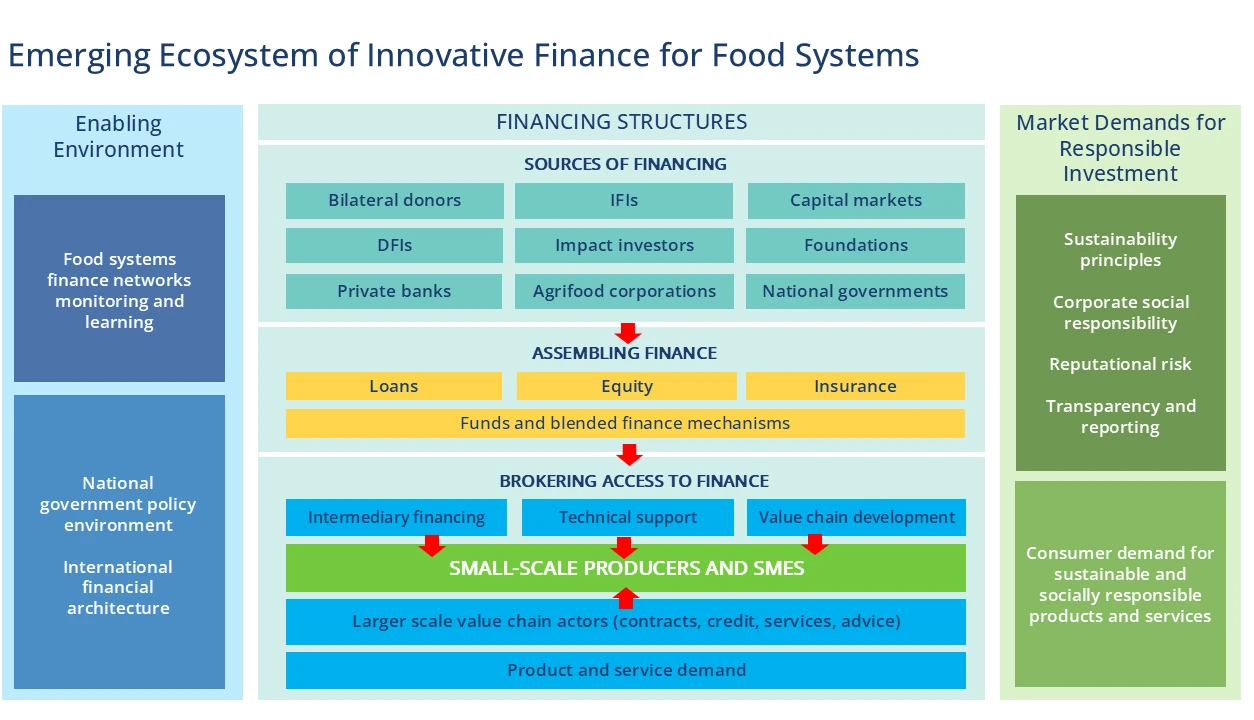
Figure 11 illustrates this emerging financing ecosystem, and emerging issues and ways forward are discussed below and in Section 6. The centre of the figure illustrates financing structures from raising finance to assembling it, which involves both different sources of finance and integrating different financial mechanisms, often done through blended finance or other types of funds. This assembled finance is then used to provide finance for small-scale producers and SMEs, often through specialised intermediary financing institutions, which need to be connected with technical support and value chain development. At this level, larger-scale enterprises also play a critical role in financing, including through credit for inputs and contracts for offtake (contracts set at the beginning of the growing season that guarantee purchase of production, which provides individual producers with financial stability knowing that they have a buyer for their production). The willingness of the financial sector to provide finance is partly driven by an increasing consumer-driven demand for corporate social responsibility, transparency, and accountability, and to avoid reputational risk. The left of the diagram illustrates the critical role that an enabling environment for finance plays both domestically and internationally, and also illustrates the emergence of networks to support learning and innovation around financing agrifood systems.
Figure 11: Illustration of key elements of an agrifood systems financing ecosystem*
- Source: Authors’ own.
5.3 Reflections on the state of innovative financing
The number of innovative and blended financing mechanisms has expanded rapidly over the last decade. There is currently no substantial meta-level monitoring or evaluation of this field. In that context, based on existing reports, available data and interviews, the following reflections are offered for further discussion.
(1) The scale of private sector finance mobilized remains modest, relative to the scale of the challenges and public sector financing.
(2) A wide diversity of new funds and initiatives have been established by IFIs, private sector companies and not-for-profit development organisations. These are forging new partnerships between different actors.
(3) Private sector engagement in financing these initiatives appears to be mainly from HICs/international corporations.
(4) Most initiatives engaging private sector finance are targeted to higher potential areas and sectors where risks are lower and operating costs are more manageable.
(5) While many of these initiatives have their own comprehensive monitoring and reporting mechanisms, there remains a significant gap in understanding collective lessons learned and overall impact.
(6) Many initiatives are relatively new, which means that their impact and long-term sustainability is still to be fully proven.
(7) While blended finance is a term being used to cover many of the emerging initiatives/funds, there is a very diverse range of financial instruments being employed.
(8) Connecting the raising of finance with “last mile” financial access and technical support for smallholders and SMEs is critical to success and is a key component of many initiatives; however, this has significant costs requiring public financial support.
(9) For impact and longer-term scaling, the financing mechanism needs to relate to effective and efficient value chain development on one end, and a demand for meeting and reporting on environmental and social responsibility principles and objectives, at the other.
(10) There is often a knowledge and understanding gap between actors and organisations of the finance sector and those of the agrifood sector. Intermediaries who understand both and can broker innovative solutions and viable deals are critical.
(11) There is a rapidly growing level of experience and lessons from innovative financing for agrifood systems; however, this remains fragmented, and poorly synthesised and shared.
Notes
-
“Financing Agrifood Systems for People, Planet and Prosperity: Towards a new pact for mobilizing capital, reforming systems, and driving transformation at scale”, https://www.donorplatform.org/wp-content/uploads/2026/02/GDPRD-White- Paper_FEB2026.pdf. Page 24. ↩